
Data Integration
Connect your systems. Move data in real time, in batch and on schedule.
We connect banking, finance and enterprise systems with proven enterprise integration patterns, so that data moves accurately, once, and with a full audit trail.
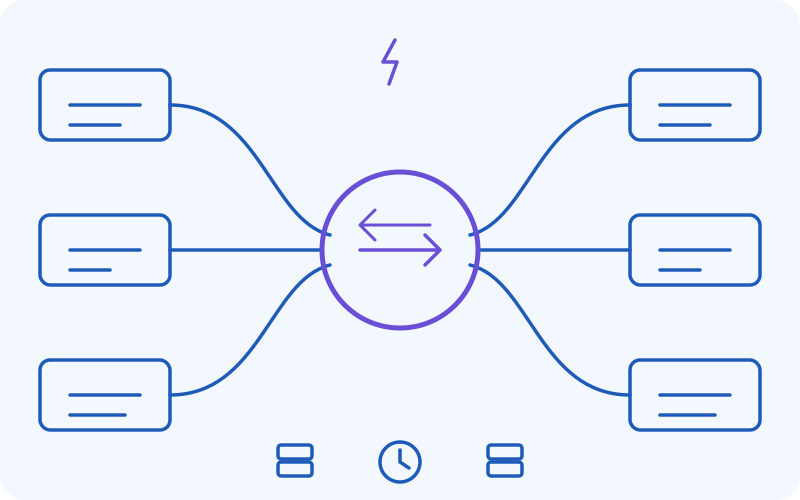
Three ways data moves
We choose the mode that fits the business need, and often combine all three in one solution.
Event-driven and API-based flows that deliver data in seconds: payments, status updates, alerts and customer requests.
Large files and bulk loads handled in controlled chunks, with validation, restart points and totals checked at each end.
Jobs that run on a calendar or a trigger: end-of-day reports, reconciliations, regulatory returns and data refresh.
Connect to the systems you already run
One integration layer, many kinds of endpoint. You keep your core systems. We connect them.
Core banking, trade finance, treasury, lending and accounting platforms, through their APIs, files or databases.
REST and SOAP services, webhooks and partner APIs, with security, throttling and versioning handled for you.
Secure file transfer (SFTP and FTP), shared folders and cloud storage, with encryption and acknowledgement.
Message queues, topics and event streams for loosely coupled, reliable delivery between systems.
Relational and non-relational databases, data warehouses and data lakes, for loading, extraction and synchronization.
Email, document stores and older mainframe or host interfaces that have no modern API.
Enterprise integration patterns we apply
We design with well-known patterns, not one-off scripts. The result is easier to run, change and audit.
Send each message to the right destination based on its content, such as the product, branch or amount.
Convert JSON, XML, CSV, fixed-width and bank formats through one agreed data model, so that each system maps once.
Split a large file into records for parallel processing, then combine the results into one response or report.
Drop what is not needed. Add reference, customer or rate data from another source before delivery.
One source publishes an event. Many systems receive it, without the source knowing who they are.
Call a system and wait for the answer, with time limits, so that users and channels get a result.
Process each message once, even when a sender repeats it. No duplicate payments or duplicate records.
Keep big files out of the message path. Pass a reference, and fetch the file only where it is needed.
Coordinate steps across many systems. If one step fails, undo the earlier steps in a controlled way.
Built to run in production
Integration fails at the edges. We design for the failures before they happen.
Failed messages retry with back-off. Messages that still fail go to a queue where operations staff can review and replay them.
Protect a slow or unavailable system from overload, and protect callers from long waits.
Control totals and record counts at both ends, with automatic matching and exception reports.
Dashboards and alerts for volumes, delays and errors. Operations staff see a problem before the business does.
Each message is traceable from source to destination. This supports audits and regulatory reviews.
Encryption in transit, controlled access to credentials and data masking where the data is sensitive.
How we deliver
A clear path from the first interface to a stable operation.
List the systems, interfaces, volumes, formats and service levels. Agree the data model and the error rules.
Choose the patterns, build the flows and test with realistic data, including failure cases.
Move data in stages. Reconcile every stage, and keep a rollback plan until the business accepts the result.
Monitor, support and tune the flows. Add new systems and interfaces without a redesign.
Frequently asked questions
Do we need to replace our existing systems?
No. We add an integration layer between your systems. Your core platforms stay in place, and we connect them through their existing interfaces.
Can one solution handle real-time, batch and scheduled flows?
Yes. The same routes, data model and error handling serve all three modes. This keeps the rules in one place.
How do you prevent duplicate or lost data?
We use idempotent processing, acknowledgements, retries with dead-letter queues, and control totals that we reconcile at both ends.
Can you support data migration and reconciliation projects?
Yes. We migrate in stages, reconcile each stage and report exceptions. See our case studies for examples in banking and finance.
Which formats do you support?
JSON, XML, CSV, fixed-width files and the formats that banks and regulators require. We add new formats through the same data model.
Let us connect your systems
Tell us which systems you need to connect. We will show you how we would do it.