
ARCIS by Fingress: document solutions
ARCIS Document Intelligence & Governance
A governed repository of record for every document, with AI extraction and maker-checker control at every step. ARCIS is a Bluescope product, born from the Fingress platform.
Why ARCIS
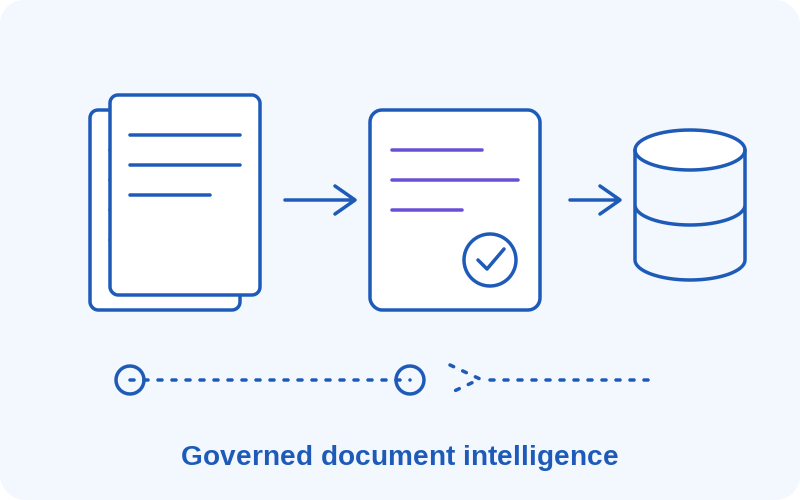
Regulated businesses re-key the same documents, re-check the same evidence and struggle to show an auditor what happened. ARCIS stores every document once, reads it with AI, routes it through dual-control approval and keeps a complete, defensible trail from upload to disposal.
Data is extracted from documents, not typed in again.
Verify a customer document once, and reuse it across transactions.
No single person can push content through unchecked.
An auditor can trace any document at any point without asking anyone.
Documents stay on the storage you choose: file system or NFS, relational database or Amazon S3.
Used by makers, checkers and approvers, back office, legal and compliance teams, records managers, auditors and IT teams.
What ARCIS includes
Document intelligence and governance in one system.
Every document moves through a content-type specific approval chain: draft, submitted, review, compliance review, approved or rejected, archived.
Classify documents and extract fields with confidence scores. Low-confidence results go to a manual review queue instead of passing through.
Retention schedules, legal hold, scheduled disposition review and authorised destruction.
Free-text and faceted search across names, content, tags, content types and workflow states.
Full version history and exclusive edit locks, so concurrent editors never overwrite each other.
Vetted templates, typed or Word-based, filled with transaction data to issue branded documents and PDFs.
Everything a regulated document lifecycle needs
One consistent pattern for any regulated industry: a maker authors or uploads, a checker reviews, back office scrutinises, legal vets non-standard documents, an approver signs off, and an auditor traces it all.
Define content types with metadata schemas, allowed file extensions, size limits, renditions and their own approval chain, or start from a curated catalogue.
Segregation of duties is enforced: the person who submits a document cannot approve it, and every return or rejection needs a remark.
Upload once, verify once. KYC and customer documents verified by back office are reused across later transactions.
High confidence is accepted automatically, borderline results are flagged for spot checks, and low confidence goes to manual review.
Retention policies per content type, legal hold that overrides disposal, a disposition review that flags (never deletes) expired records, and destruction only on explicit authorisation.
Folders, sharing with users and groups, annotations pinned to a position on a document, notifications, and a versioned file store.
Auditors raise, track and close observations against records, with dashboards across tenants and content types.
Tenants, users, groups and custom roles managed per tenant, with per-tenant branding and storage quotas.
Fits into the systems you already run
Built to be called by your channels and core systems, and to bring legacy content in without a big-bang cutover.
Every capability, from upload and approval to search and records actions, is available through a tenant-scoped REST API with consistent error responses.
A ready-made Java client with retries, circuit breaker, token handling and metrics, also shipped as a single shaded JAR for application servers such as WebSphere.
Push and pull transaction data to and from core systems, such as trade finance back offices, as documents move through their lifecycle.
Resumable, checksum-verified migration from file systems, Amazon S3, Google Drive, JDBC databases and HTTP archives, which survives restarts.
Extraction runs through a provider interface. Google Cloud Document AI is supported today, with an offline provider for testing and room to add others.
Apache Tika extracts text for search, and LibreOffice renders Office documents for preview and PDF output.
Controls designed in, not bolted on
Security works at four independent layers: who you are, what you may do, whose data you can reach, and a tamper-evident record of what you did.
Stateless JWT bearer tokens and HTTP Basic, with bcrypt-hashed passwords. Tokens verify on any node, so clusters need no shared session store.
Permissions such as read, write, review, approve and archive are composed into the roles of each tenant, and checked on every service call.
Documents and folders are private until shared. Access is granted directly or to groups, and cascades through folders.
The content of each tenant lives in its own repository subtree, and every request is checked against the home tenant of the caller.
The platform sets a minimum control level per tenant. Tenants can design stricter approval chains, never weaker ones.
Creating, disabling or enabling users requires approval from a second administrator.
Tenant, content-type, user and document events are recorded in an append-only log, with remark and version history on every record.
Credentials for migration sources are encrypted at rest.
Built on Apache Jackrabbit Oak
ARCIS is built on Apache Jackrabbit Oak, the open-source, standards-based (JCR) content repository from the Apache Software Foundation, so your records sit on a proven, vendor-neutral foundation, not a proprietary store.
Java Content Repository (JCR) API, with hierarchical content and versioning.
Apache License 2.0, with no repository lock-in.
From a single node to a cluster sharing the same content store.
The application does not change when the back end does. Separate control plane for users, permissions and audit on PostgreSQL or Oracle.
Keep documents where your organisation wants them
Choose the storage back end per deployment. Changing it is configuration, not a re-build, and governance works the same on all of them.
Binaries in a de-duplicated file data store on local disk or a shared NFS mount. The simplest single-node option.
Content and binaries in the PostgreSQL or Oracle database you already operate and back up. Several application nodes form one cluster.
Binaries in Amazon S3 buckets or S3-compatible object storage such as MinIO.
Content tree on MongoDB for horizontally scaled, multi-node deployments.
Put your documents under governance
Talk to us about ARCIS Document Intelligence and Governance.